Medical Inventions
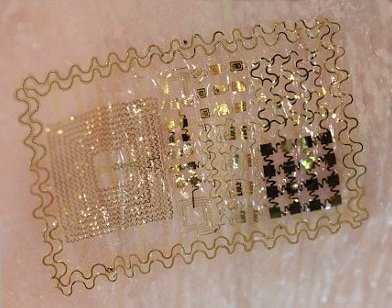
The latest in medical inventions is a hair-thin, stick-on micro-electronic tattoo.
It is applied to the skin like any ink transfer tattoo. You rub a backing sheet onto your skin - peel it off - leaving the tattoo transfer on the surface.
The tattoo is made from a rubbery polymer substrate that has similar properties to skin. It has the same thickness, mass and elasticity.
It can bend, stretch and wrinkle just like real skin and contains advanced circuit components (transistors, diodes, and semiconductors) that can monitor functions in your body, such as heart rate, brain waves, neuro-muscular activity and wound healing.
Powered by solar cells, the data collected can be transmitted wireless to a remote computer for analysis.
Scientists believe that this medical invention could be used to monitor more subtle processes, such as the movement of enzymes, antibodies, or pathogens.
The med-tech tattoo was developed by collaborating scientists from universities in the United States, China and Singapore.
Funding for this invention was provided by the Air Force Research Laboratory, the US Department of Energy, the National Science Foundation, the Beckman Institute for Advanced Science and Technology, the University of Illinois, and the Defense Department National Security Science and Engineering Faculty Fellowship.
Source: sciencemag.org
Infant Warmer
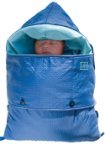 Sometimes it's the simplest of medical inventions that save millions of lives. Meet inventors Jane Chen and Rajan Patel, and their innovative infant warmer.
Every year 20 million babies are born premature. They struggle to survive because they can't regulate their body temperature and they don't have enough fat on their tiny bodies to keep warm.
Approximately 14% of babies born are considered low birth weight, but these babies account for 60-80% of neonatal deaths.
The solution is to keep premature babies warm but an incubator costs $20,000 and requires electricity which is difficult to find in developing countries, particularly in rural areas.
Parents resort to drastic solutions to keep their babies warm. They attach hot water bottles to them or place them under light bulbs, which is not only ineffective but unsafe. As a result, 4 million premature babies die each year. Two-thirds of deaths occur in ten countries and 40% of those occur in India.
Those that survive endure severe long term health problems (diabetes, heart disease, mental dysfunction) because they're battling hypothermia instead of growing.
To solve this problem Jane and Rajan, graduates of Stanford University, created an ingeniously simple, portable, reusable infant incubator that requires no electricity and costs less than thirty dollars.
It is safe and intuitive to use. It has no moving parts and can be easily sterilized. It looks like a tiny sleeping bag but it's design is very clever.
It has a pouch that contains a "phase-change wax material" that radiates heat throughout the insulation at a temperature of 37 degrees Celius (98 F) - the temperature critical for the child's survival.
The pouch is removed from the insulated blanket and activated by placing it in hot water for 15 minutes. It's then placed into the blanket.
The phase-change material maintains a constant temperature for 4 hours by absorbing heat if the baby gets too hot, and giving heat if the baby gets too cold.
Sources: embraceglobal.org; ted.com/talks/jane_chen_a_warm_embrace_that_saves_lives.html
Contacts Measuring Glucose
Jin Shang, a professor of biochemical engineering at the University of Western Ontario, has invented a contact lens that changes color when sugar levels change in the blood.
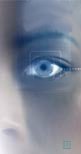 Those suffering from diabetes need to draw blood to check sugar levels.
Nanoparticles implanted in contact lenses interact with glucose molecules in tears. This interaction changes the color of the lens to indicate varying sugar levels.
This new medical invention could eliminate the need to draw blood to monitor glucose.
Dr Zhang's research received funding from the Canadian Foundation for Innovation to develop more nanocomposite applications for biomedicine.
Source: eng.uwo.ca/people/jzhang
Acne Cure Natural Ways
Dissaya Nu Pornpattananangkul, a doctoral bioengineering student at the University of California San Diego (UCSD) has invented an innovative system for treating acne and keeping skin clean. The new technique uses nanoparticles (nano-bombs) that seek and destroy bacteria causing acne. The "nano-bombs" use natural ingredients to treat acne without the side effects of burning or the red skin associated with drugs.
These nanoparticles carry liposomes with lauric acid into the skin microenvironment. The nanoparticles locate acne bacteria and the lauric acid then attacks and kills the bacteria.
A liposome is a tiny bubble made out of the same material as a cell membrane and it is filled with lauric acid. Lauric acid is a saturated fatty acid which has antimicrobial properties. It is found in coconut oil, palm kernel oil, human milk, cow's milk and goat's milk. Nanotechnology has created a new frontier for image of doctor holding medical invention.
Source: ucsd.edu
Sugar Glass Preserves Vaccines
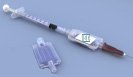 Scientists at Nova Bio-Pharma Technologies and the University of Oxford have invented a rectangular cartridge that can store vaccines without refrigeration.
Vaccines currently need to be transported and stored in refrigerators, which greatly increases costs, limits access and reduces the vaccine efficacy.
Vaccines must be refrigerated between 4 °C to 8 °C to stay effective. This increased cost is between 14 to 20 percent (an average of $200 million for most countries).
In developing countries, where refrigeration and electricity are often scarce, vaccination is non-existent.
This new medical invention seals live vaccine viruses inside sugar. The trapped vaccines can be stored at temperatures of 45 C without any degradation for months.
The process mixes the live viruses with sucrose and trehalose. The solution is then dried on a plastic film that hardens into a sugar-glass cartridge.
The vaccine is immobilized and kept in suspended animation inside the sugar-glass. When needed the cartridge is simply screwed into a standard vaccine syringe for injection.
Sources: novalabs.co.uk;technologyreview.com
Negative Pressure Medical Device
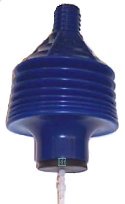 MIT graduate student, Daielle Zurovcik, invented an inexpensive, portable wound-healing device.
After surgery a patient requires care for an amputated limb or the open wounds of a fractured bone. Vacuum pumps speed healing by removing bacteria and fluids that accumulates on, and around the injury.
The cheapest model on the market goes for about $100 a day rental, and weighs about five to 10 pounds, which creates a barrier for utilizing these devices in medical relief efforts sent to disaster zones.
"My experience in Haiti and other major earthquakes is that after the acute medical response, such as amputating limbs and setting fractures, the major disease burden is wounds," says trauma surgeon Robert Riviello.
The pump Zurovcik invented costs about $3 and weighs less than half a pound. Once a wound dressing is sealed to prevent air leaks, her hand pump can be used to create the required vacuum without any external power source.
Traditional pumps require 14 watts of electricity; Zurovcik’s pump needs only 80 microwatts to function.
Source: technologyreview.com Photo: Daniell Zurovcik