Great Inventions

This page is about neodymium magnets, video games, maglev trains, and other great inventions.
Neodymium magnets are permanent dense magnets that produce powerful magnetic fields and are highly resistant to being demagnetized.
This makes them ideal for use in electronics or any electromagnetic application requiring a reduction in size but an increase in power (power to weight ratio).
These magnets are used in a wide range of products - from computer hard drives, headphones, audio speakers, cordless tools, magnetic resonance imaging equipment (MRI), electric motors, hybrid and electric vehicles, airplanes and trains, to self-powered flashlights, fasteners and toys.
Rare Earth
Neodymium magnets were invented in the early 1980's by two groups of physicists working independently from one another.
One group was led by John J. Croat of the General Motors Physics Laboratory, and the other was led by Massato Sagawa of Sumitomo Special Metals in Japan.
Both groups invented different manufacturing processes to produce neodymium magnets, which are made from rare earth elements.
Rare earth elements have chemical properties that make them very easy to magnetize with a high magnetic field strength. Rare earth elements have chemical properties that make them very easy to magnetize with a high magnetic field strength.
Despite the name "rare earth", these elements (metals) are not scarce but widely dispersed in the earth. The reason they're called "rare" is because it is rare to find them in any concentration that is cost effective for mining and extraction.
Despite the name "rare earth", these elements (metals) are not scarce but widely dispersed in the earth. The reason they're called "rare" is because it is rare to find them in any concentration that is cost effective for mining and extraction.
Neodymium magnets emit powerful magnetic fields relative to their size and can cause damage to credit cards, hard disks, or electronic devices.
The magnets should not be placed in direct contact or near anything that uses magnetism.
They're also potentially fatal if swallowed, so for these reasons neodymium magnets are not recommended for children's use.
Sources: jap.aip.org; theneocube.com
Video Games
 In 2006, inventor Ralph Baer was awarded the
National medal of Technology for his
contribution to video game development.
In 2006, inventor Ralph Baer was awarded the
National medal of Technology for his
contribution to video game development.
The 91-year-old Baer is considered the father of video games because he was the first person to invent the concept and the electronics for playing them.
In 1966, while working as an engineer with the defense-electronics company Sanders Associates, Baer developed a system that used a television to play video games.
This invention was licensed to a company called Magnavox and they marketed the product as Magnavox Odyssey
As well as being a recipient of the National Medal of Technology, an award presented to him by the President of the United States, Ralph Baer is also an inductee in the National Inventors Hall of Fame.
In the following three-minute interview, Baer talks about his inventions, his career, and describes himself as an artist. "I'm no different than a painter," he tells us.
Maglev Train
 If you don't like flying or want to
avoid airport congestion, delays,
restrictions and cancellations, there
isn't an alternative for
long distance traveling.
If you don't like flying or want to
avoid airport congestion, delays,
restrictions and cancellations, there
isn't an alternative for
long distance traveling.
Every other means of transportation is just too slow. But that may change. Magnetic Levitation Trains (Maglev Trains) use electromagnetic propulsion and suspension to reach speeds over 310 mph (500 km/h).
At that speed, a trip from Rome to Paris on a Maglev would take 2 hours but engineers believe the trains will get faster.
Maglev train systems are being built or are planned for construction on most continents. Currently, the fastest Maglev train in the world is in Shanghai, China.
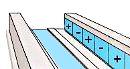 How it works. Magnets underneath the
track levitate and float the train.
How it works. Magnets underneath the
track levitate and float the train.
Along the sides of the track is a guide rail with magnetic coils that alternate polarity to interact with magnets on the train.
Opposite poles attract and like poles repel. So the magnets on the guide rail alternate to repel (push) and attract (pull) the train along the track.
Since nothing is actually touching the train other than an electromagnetic field - there is no friction, which means less resistance and greater acceleration. There is also no engine, which means less weight.
The main impediment to speed is air resistance, which is why engineers are excited about sending Maglev trains through vacuum tunnel-tubes. If this was to occur then Maglevs could potentially reach super-sonic speeds.
Sources: transrapid.de; smtdc.com
See More - Great Inventions