Inventor Reveals How to Profit
Selling Invention Ideas...
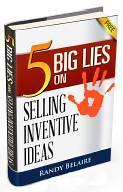
Our publisher is giving away copies of my best selling eBook!
Get your FREE COPY before midnight tonight.



Does selling your idea seem difficult, complicated, confusing and expensive?
There are a lot of people giving advice who have never invented anything or made any money from inventing anything.
How about the advice you're getting?
Do you get different opinions on what you should be doing?
Has anyone suggested that you're wasting your time? Are you frustrated about the access you have to resources?
When I first started, I had nothing to show for my efforts but debt and an ever increasing list of people who confused me.
Maybe you can relate.
For some reason only a small percentage of innovators are successful.
In fact, 93% of new ideas are never commercialized.
Obviously, something is wrong here!
 My name is Randy Belaire and my ideas and businesses have generated millions of dollars in revenues.
But I made lots of mistakes trying to convince others that my ideas had value.
I had a lot of learning to do and realized that my priorities were all wrong and needed to change if I was going to be successful.
What's Wrong
Here are some interesting statistics.
In the United States there are 32,797 patent attorneys and agents.
The national average billing rate is $250 per hour.
That amounts to over 8 million dollars an hour, if there is enough work for everybody.
This generates 93% of the patents that are never commercialized.
According to the Federal Trade Commission, invention promotion companies collect an estimated 300 million dollars annually from inventors yet their success rate for commercializing inventions is less than 1 percent.
Would you follow the advice of someone who had a 1% success rate?
Here's The Truth
There is considerable misinformation about what is important and what steps you should take with an inventive idea.
We're told to do the wrong things, at the wrong time, in the wrong sequence, for the wrong reasons with the wrong people.
Why is this happening?
It happens because some people don't really know what works and others are just trying to sell you stuff.
Most of the stuff is not important and some of the people selling you services don't really care about your ideas - they only care about selling you their services.
The Fairy Tale
It's a fairy tale that all you do is give someone all your money and you'll get rich from your idea.
I've never met anyone that has done this simple two-step get
rich scheme.
All the rich innovators I know have never done this.
You absolutely can get rich with a great idea, but there are key steps between getting the idea and making money and these key steps are common to all successful inventors.
Success
Many of us believe that we can't talk about our ideas to anyone until we spend thousands of dollars protecting and perfecting them.
This isn't actually true.
Many of us are given misinformation about how to promote our inventive ideas and how to get people interested in them.
Success is directly related to convincing others that your idea will help them achieve their goals. Sometimes that means making a lot of money but often it means something else.
You may be wondering how you do that without spending a lot of money yourself?
I'm going to tell you.
Once you get your free copy of my eBook, be sure to read Page 39. That's
where you'll find the single most important factor
that determines the success of any new idea. You'll also discover on Page 67 the most important
skill used to make any idea successful. And on page 94 you find how to turn your ideas into
valuable products.
The true value of a patent and how to use it. The powerful secret that reveals the one thing investors want to know. What determines a money making idea. The shocking truth that causes most entrepreneurs to fail - even if they have money and a great idea. The biggest mistake inventors make about licensing their inventions. The most important skill used by all successful entrepreneurs. The correct sequence of steps to take for invention success. 




|
|
|
|
The true value of a patent and how to use it. The powerful secret that reveals the one thing investors want to know. What determines a money making idea. The shocking truth that causes most entrepreneurs to fail - even if they have money and a great idea. |
|
The biggest mistake inventors make about licensing their inventions. The most important skill used by all successful entrepreneurs. The correct sequence of steps to take for invention success.  |