Invention of the Microscope
The invention of the microscope, like the telescope, is credited to a 17th century eye-glass maker in Holland.
Merchant traders would determine the quality of woven goods by the number of threads in a fabric. They would use a magnifying glass to count the threads.
As an apprentice in a dry goods store, Anton van Leeuwenhoek, decided to experiment with methods of increasing the magnification of glass lenses.
He wanted to count threads more easily.
Leeuwenhoek was able to grind and polish extreme curvatures in glass, which he used to create the first microscope.
The magnification was so great that he could not only count thread more easily, be he could also observe things that were never seen before.
Leewenhoek was the first to discover the existence of bacteria and yeast, as well as tiny life forms living in drops of water.
This observation by magnification became known as the science of "microscopy" from Greek micron meaning "small" and skopein meaning "to look or see".
Microscopy
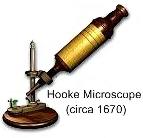
The English scientist, Robert Hooke, made improvements to the microscope by increasing its magnification capabilities.
 In 1665, Hooke published a book entitled "Micrographia" where he first coined the word "cell" to describe the appearance of plants viewed with a microscope.
Hooke decided to use the word "cell" because what he observed in his microscope reminded him of the rows of small rooms used by monks as dwellings - known as "monk cells".
Hooke's microscopic observations allowed him to accurately theorize that fossils were the remains of living things that were petrified. He argued that studying fossils could provide valuable information about the past.
The original microscope used by Hooke is currently on exhibit at the National Museum of Health in Washington, DC. It was hand crafted from leather and gold tooled by Christopher White of London, England in 1670.